The full month, in seconds
Roster, shifts, and per-service minimums go in; the month's schedule comes out. The engine honors Chile's Labor Code — free Sundays, rest rules, contract hours — and covers every service without overstaffing.
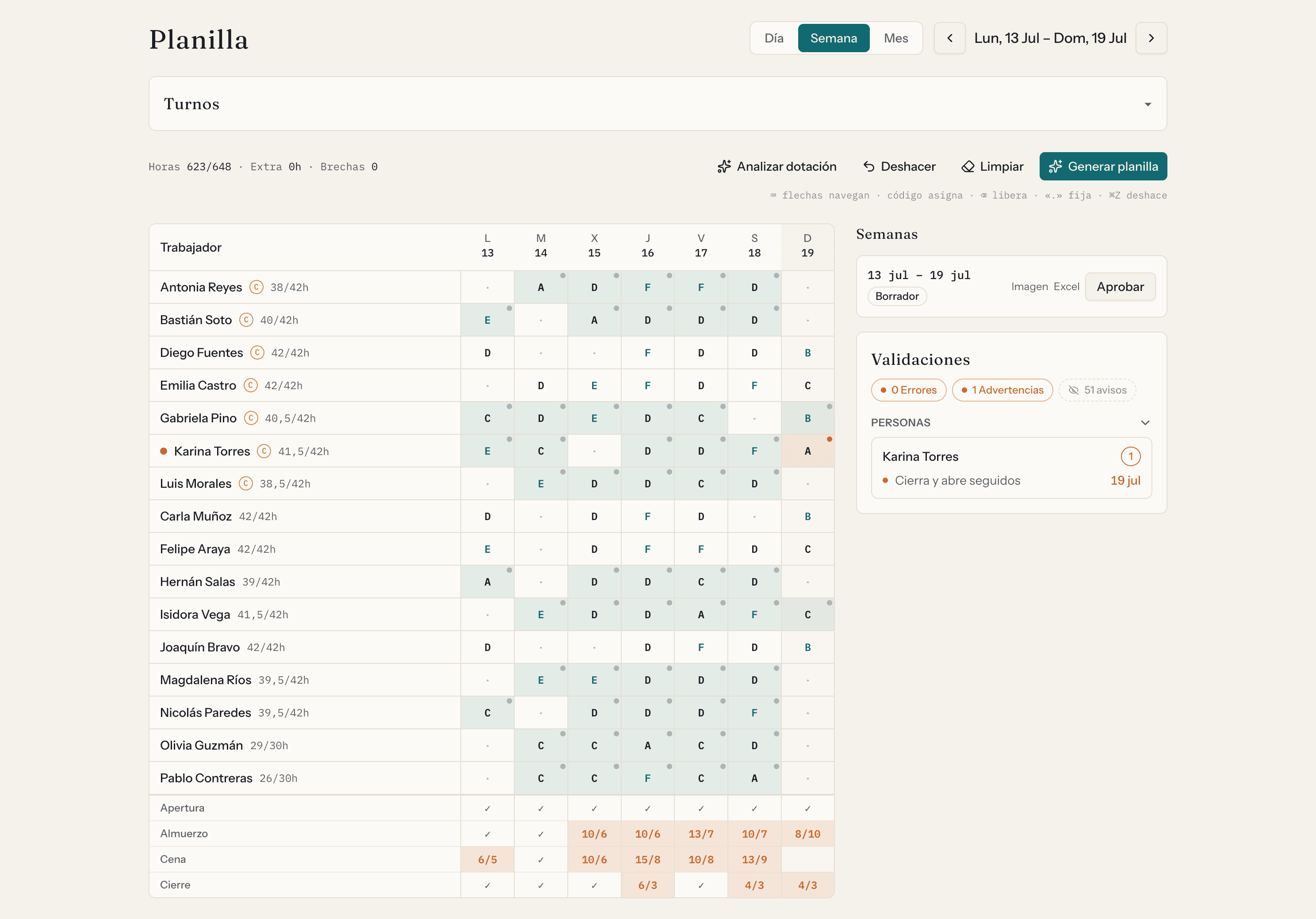
One week generated by the engine — untouched, fictional roster
Connected to your whole operation
Clocking in with GeoVictoria or Buk? HR on Talana? Sales through Toteat? These are the platforms Chilean restaurants already run on — connect them with your own credentials: the roster imports itself, the published schedule reaches time-and-attendance, real attendance flows back into your reports, and POS sales turn labor cost into a share of revenue.

Service is won at the pass, not in a spreadsheet.
What is Batuta?
A schedule composer: an optimization engine builds your team's full month of shifts, honoring Chilean labor law, each contract, and every service's coverage minimums. You review, tweak anything you want, and publish week by week.
Who is behind Batuta?
Two people: a software engineer with more than twenty years programming and more than ten building products, and a hospitality professional with years of service, restaurant management, and culinary training as head of program at a culinary institute. The engine is engineering; the rules — how you build a schedule that survives a real service — come from the trade.
How much does it cost?
Between $60,000 and $150,000 CLP per location per month, depending on the savings Batuta generates for you. We start with a free pilot that measures your real savings and set a simple per-location price from that number. Never more than $150,000, and always a fraction of what you save. You can estimate it right now with the calculator.
Does it replace GeoVictoria, Buk, or Talana?
No: it integrates with them. They're the platforms Chilean restaurants already use — GeoVictoria for time and attendance, Buk and Talana for HR and payroll, Toteat as POS. When you publish a week, Batuta can push the schedule to GeoVictoria or Talana, pull real attendance back, and cross POS sales against labor cost with Toteat. Your current stack stays.
Does it comply with Chilean labor law?
Yes — the Labor Code's rules run inside the engine: at least 2 free Sundays a month (Law 20.823), weekly rest, at most 6 consecutive workdays, a week of at least 5 worked days, 33 hours of rest around the day off, and each contract's hour cap. If you edit by hand, validation flags instantly when something breaks. Chile is the first market: for an operation elsewhere, we'd work with you to encode your country's rules.
How long does implementation take?
Days, not months. We load shifts, contracts, and coverage with you (or import them from GeoVictoria or Talana) and the first schedule ships that same week.
What happens with my data?
It's yours and is used only to compose your schedule. This site uses no cookies and its analytics are anonymous. Your team's data is never sold or shared, except through integrations you activate yourself. More detail under Privacy.
Coda
We're just getting started — and that works in your favor.
Our first customers work directly with the people building Batuta: we configure it with you, tune it to your operation, and your feedback shapes what comes next. We start with a hands-on pilot, and the price — simple, per location — is set together once it has proven its value.
Prefer email? hola@usebatuta.com